



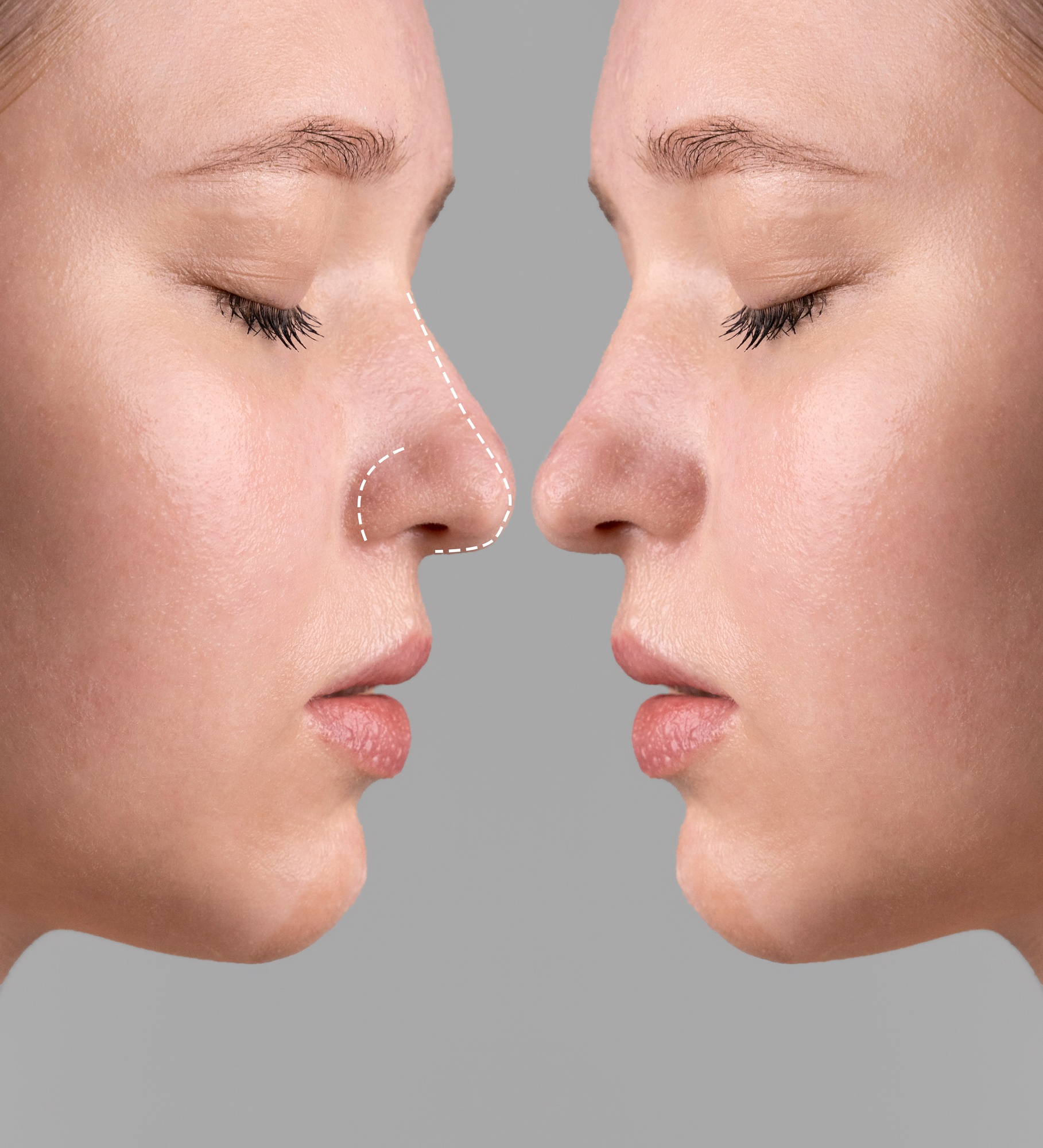







Facial beauty does not arise from the aesthetics of a single feature, but from the harmony of all facial elements working together. One of the key components in achieving this harmony is rhinoplasty (nose surgery). Today, aesthetic surgeons often use the concept of the “golden ratio” to create natural and balanced results. But what exactly is the golden ratio in rhinoplasty? And is it truly possible for everyone to achieve a profile that harmonizes with their face?
What Is the Golden Ratio?
The golden ratio (1.618) is a mathematical value that forms the basis of aesthetic perception in nature, art, and architecture. When applied to facial proportions, it aims to achieve a look that is both visually pleasing and naturally balanced. In rhinoplasty, this ratio is associated with several factors, such as nose length, width, tip shape, and the nasolabial angle.
The Role of the Golden Ratio in Rhinoplasty
Since the nose is located at the center of the face, it plays a crucial role in facial symmetry. A nose designed in accordance with the golden ratio typically exhibits the following features:
-
The nasal tip is neither overly upturned nor drooping.
-
The nasal bridge is straight or gently curved (depending on face shape).
-
The nose width is proportionate to the width of the face.
-
When viewed in profile, the nasolabial angle should be approximately 95–105° for women and 90–95° for men.
However, it’s important to note that the golden ratio is a guideline, not a strict rule. Every individual has a unique facial structure, ethnic background, and aesthetic perception. For this reason, surgeons create a personalized plan based on the patient’s specific expectations and features.
Is the Golden Ratio Suitable for Everyone?
Applying the golden ratio exactly in every case doesn’t always yield the best aesthetic result because:
-
Facial features are unique to each individual.
-
Cultural perceptions of beauty can vary.
-
A natural appearance is often more desirable than “perfect” proportions.
The goal of rhinoplasty is not to achieve a textbook-perfect nose, but rather to create a look that fits and enhances the individual’s overall facial features.

Design Based on You, Not Just the Golden Ratio
With advancements in technology, personalized nose designs can now be created using 3D simulations before surgery. This allows the patient to see how their new nose will harmonize with their facial features ahead of time.
Conclusion
The golden ratio serves as a valuable guide for plastic surgeons, but the ultimate goal in rhinoplasty is to achieve a natural, balanced appearance that complements the individual’s unique facial structure. With a custom-tailored nose design inspired by the principles of the golden ratio, you too can achieve the profile you’ve always dreamed of.